Develop your slate against each writer’s own voice profile.
Development infrastructure for vertical drama producers, built on each writer’s own voice profile.
House Rules, live today
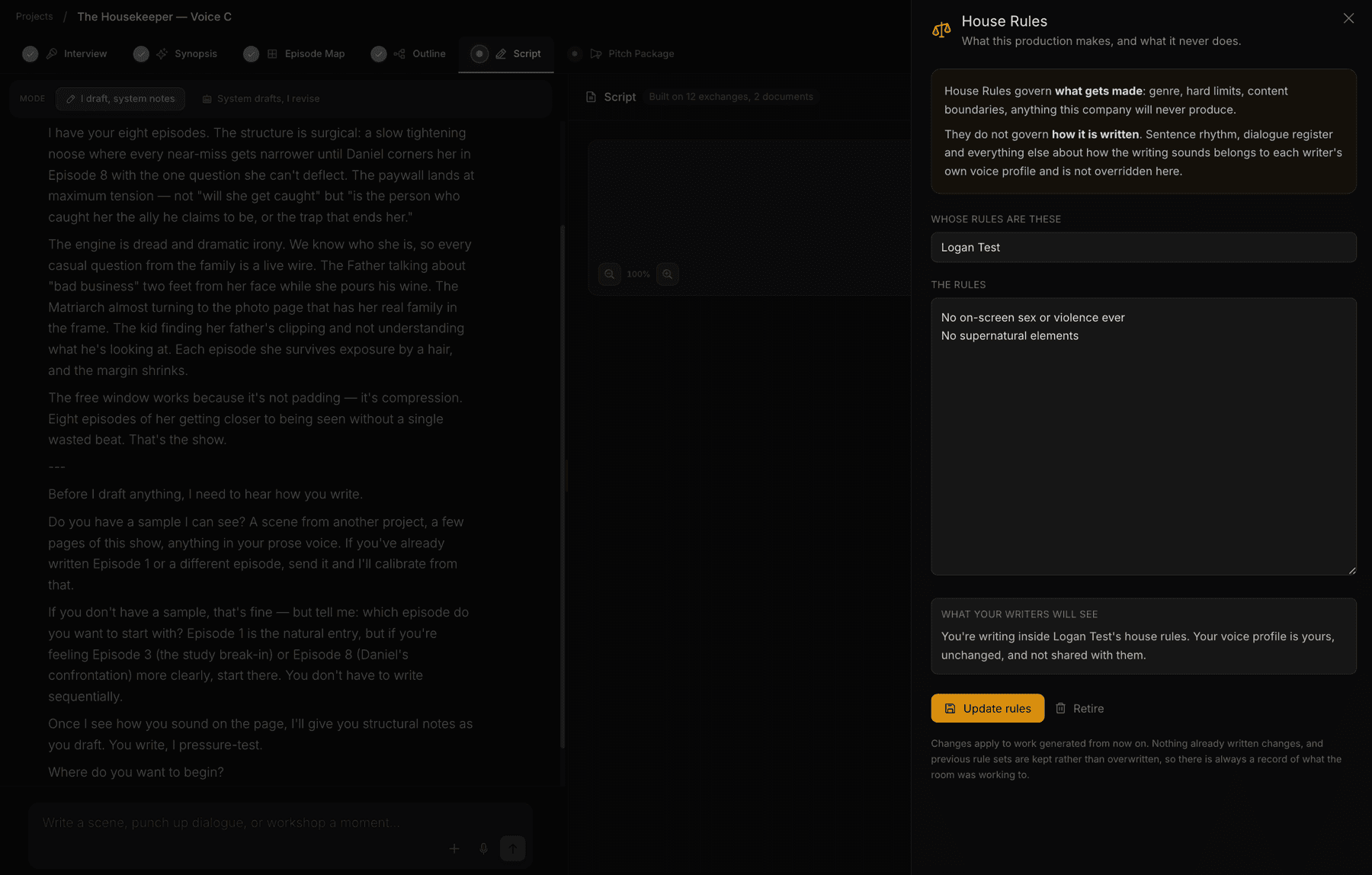
Your content boundaries set once and enforced across every writer in the room. They govern what gets made, never how it is written.
“First Read has delighted me in a way I didn’t think possible. It delivers a kind of pushback that shows you it was created by writers for writers.”
The problem you actually have
A vertical production company lives or dies on development throughput. Your writers ship 60 to 100 episodes per series on compressed cycles, and development is the bottleneck, not the shoot. Generic AI can produce scripts at scale, but the scripts sound generic. The thing that makes your slate yours gets diluted every time you scale.
What First Read is
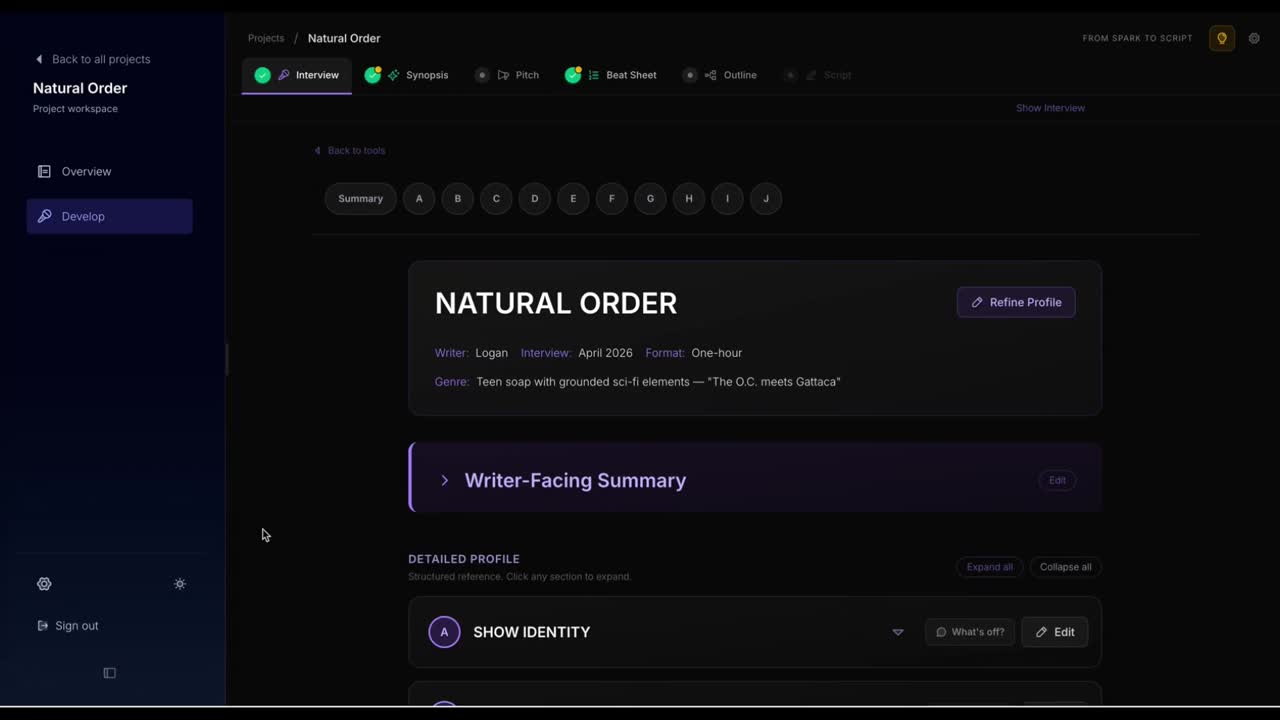
First Read is development infrastructure built on voice profiles. Each writer sits for one structured voice interview of roughly 30 minutes. First Read then develops against that writer’s profile across the full pipeline. Same speed as generic AI. Every stage measured against their own standard. Your stated content boundaries applied once across every writer on the project.
The house sets the rules. The writer keeps the voice.
What it does for your operation
Development against each writer’s own voice profile, at production scale
Each writer sits once for a structured voice interview. Every document generated afterwards carries their voice, at the speed of generic AI.
House Rules, live today
Your content boundaries: genre, hard limits, anything the company will never produce. Stated once and visible to every writer on the project. They govern what gets made, never how it is written.
Producer-facing outline format
Output your development execs can read and note without translation.
ACMI
Ad-cliff moment indexing for vertical, built for the way the format actually monetises.
Ready for the disclosure moment
When a buyer, guild, or platform asks what was AI-assisted, you have an answer already prepared rather than a scramble.
Cryptographic voice-profile provenance
Each profile is signed, and anyone can verify the signature without us. That establishes which profile a document was made against and that neither has changed since. It does not prove who typed the words, and the record says so.
This is a complement to WGA registration, not a replacement for it. Registration gives you one dated deposit of a finished draft. This gives you a continuous, per-save record of how the work actually got there, and anyone can check it without us.
Proof it works
- First B2B production-company partner in active beta.
- Working writers across network drama and vertical, including paying subscribers.
- Testimonials from working showrunners and executive producers.
- Two provisional patent applications filed with the USPTO.
We never train AI on your work, and your material is never used to improve a model for anyone else.
Let’s find out if it fits
Thirty minutes, no deck. We look at your slate and your bottleneck.
Book a 30-minute call